CUPE 1943

Upcoming Media Conference from CUPE

“We are in survival mode:” new academic study shows staffing crisis taking harsh toll on hospital nurses, harming patient care – CUPE press conference at Queen’s Park 10 a.m. Monday

63 per cent of nurses have experienced dread going to work, according
to new Nanos poll

TORONTO – A new academic study based on in-depth interviews with hospital nurses in Ontario shows extreme levels of physical, mental and emotional burnout due to understaffing. A failure to provide adequate funding is driving cuts in staffing that are crippling morale and damaging patient care, the report finds.

“The nurses told us that they are demoralized, exhausted and finding it nearly impossible to meet patient needs in the current system,” said Jim Brophy, adjunct proferssor at University of Windsor and co-author of the study. “The root cause of this crisis is the government’s focus on fiscal restraint, which filters down to hospitals prioritizing economic efficiencies over human needs.”

We are in survival mode: what nurses need you to know was co-authored by Dr. Brophy and Dr. Margaret Keith, and approved by the University of Windsor research ethics board. The research was commissioned by CUPE’s Ontario Council of Hospital Unions, which represents nearly 50,000 health care workers including approximately 16,000 nurses.

Dr. Brophy will present the findings at a press conference at Queen’s Park on Tuesday at 10 a.m. He will be joined by Michael Hurley, president of OCHU-CUPE, and Angela Hodgson, a registered practical nurse represented by the union.

On Monday, the union will also be revealing findings of a new poll of 550 nurses across Ontario, conducted by Nanos Research. The survey shows 63 per cent of nurses have experienced dread going to work.

 Who:     Dr. James Brophy, researcher affiliated with the University of Windsor
Michael Hurley, president of OCHU-CUPE
Angela Hodgson, chair of OCHU-CUPE’s nurses committee

What:    Media conference to release findings of new study about nurses’ working conditions

Where:  Queen’s Park media studio, 111 Wellesley St W, Toronto

When:   10 a.m. on Monday, November 23

 For more information, contact:

Zee Noorsumar

CUPE Communications

znoorsumar@cupe.ca
647-995-9859

Upcoming Rally in Ottawa

If you are interested please reach out as soon as possible so we can organize a bus from Peterborough to Ottawa.

RPN Telephone Survey

Hello everyone,

Nanos Research is currently conducting a telephone survey of OCHU’s RPNs  about working conditions in hospitals, and the consequential impact on patient care and their own well-being.

This is part of an important research project promoting the voices and experiences of nurses in a bid to achieve minimum nurse-to-patient ratios in hospitals, complementing an academic study on the subject that OCHU will be releasing publicly on November 23rd.

We would really appreciate it if you could inform your RPN members about the value of participating in this telephone survey, which runs until Nov. 17. A high participation rate would result in more media coverage and public attention, and a stronger campaign.

Thank you.

Michael, Kevin, and Sharon

Article 15.06 – Call Back

Article 15.06 – Call-Back: Know Your Rights
OCHU has successfully defended members’ rights under Article 15.06 of the collective agreement.
 
Article 15.06 – Call-Back states:
“Where employees are called back to work after having completed a regular shift, and prior to the commencement of their next regular shift, they shall receive a minimum of four (4) hours of work or four (4) hours of pay at the rate of two (2) times their regular hourly earnings.”
 
What does this mean for members?
If you have completed your regularly scheduled shift and your employer calls you back to work before your next regularly scheduled shift begins, Article 15.06 applies.
 
The article provides for:
-A minimum of four (4) hours of work or four (4) hours of pay.
-Compensation at double your regular hourly earnings.
-The entitlement applies even if you are required to work less than four hours.
 
When does call-back apply?
There are three important considerations:
1. You must have completed your regular scheduled shift.
2. You must be called back to work after completing that shift.
3. The call-back must occur before your next regularly scheduled shift begins.
 
OCHU maintains that employees should receive the protections negotiated under Article 15.06 when they are required to return to work between regularly scheduled shifts.
 
In the arbitration case OCHU took on and won, the Union argued that the employee had completed their regular shift on January 2, was called back to work on January 3, and was not scheduled to return until January 5.
 
The Union argued that the hours worked on January 3 were subject to double-time compensation under Article 15.06 which the arbitrator allowed the grievance.
 
Know your rights. Contact your Local Union.

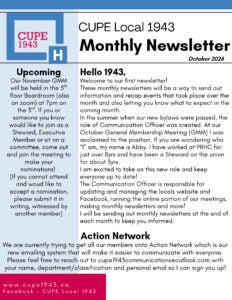
Action Network QR Code

It is really important that we have all members up to date personal emails.

It takes less than a minute to fill out!